A Swarm of Lemmings:Writers' Passive Suicide and the Crisis in K-12 Literacy – Implications for Western Civilization
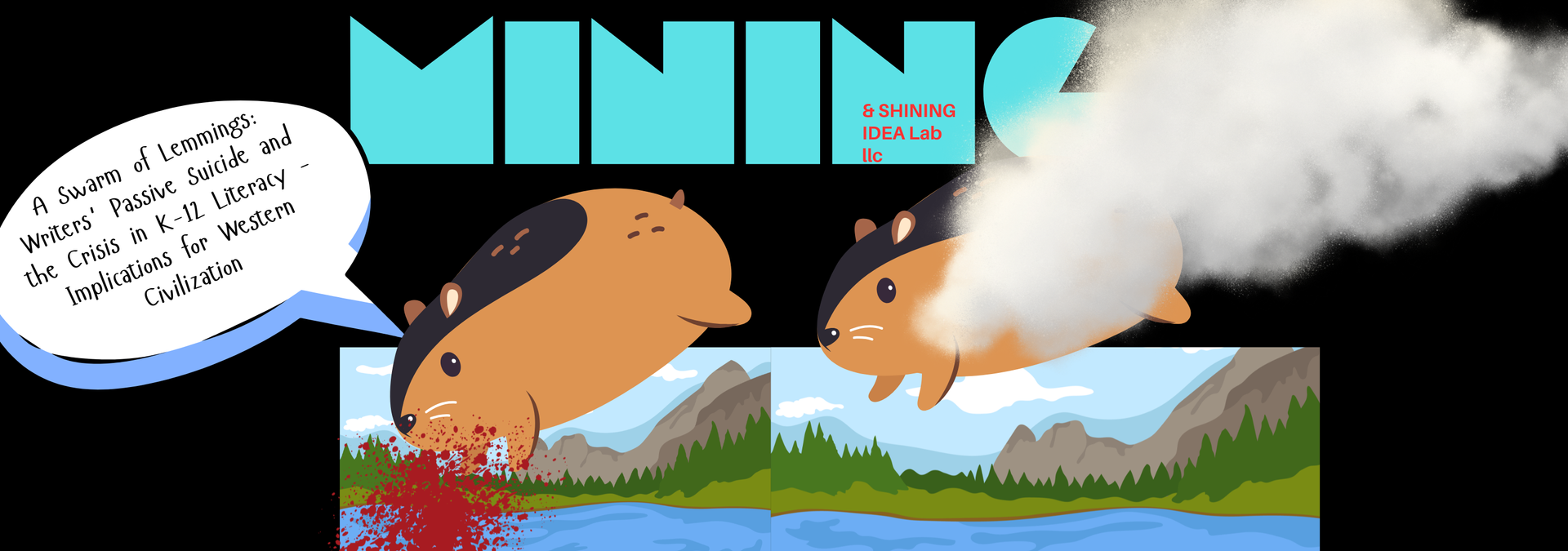
A swarm of lemmings continues their march to the proverbial sea, attracted by a temporary vision of sun and beauty, but ultimately distracted by that vision—thus, they fall off the cliff in a passive suicide. It wasn’t a conscious decision. Their deaths were the consequence of distraction alone.
In this allegory, the lemmings are writers (and many in publishing) who ignore the erosion in elementary schools and K-12 education. Writers may create brilliant work, but if students graduate without the skills to engage deeply, our audience vanishes. From a cultural perspective, this is alarming—and the stakes extend to the health of Western civilization itself.
In my day job, as Executive Director of a small non-profit, I oversee a pre-K program, a charter school, and our efforts to revitalize a publishing company re-dedicated to high-quality children's books, which we're strongly considering. These trends hit close to home: we're building foundations early because the data shows the stakes are high—not just for individuals, but for the shared knowledge, critical reasoning, and civic discourse that have sustained Western democratic traditions for centuries.
Key trends:
- Average Grade Level of Books Sold Now vs. 1950: Decline Toward Grade 5–7
Bestsellers today often score 5th–7th grade on Flesch-Kincaid (many 4th–6th for broad appeal), with simpler sentences and vocabulary to match declining adult reading stamina. Mid-20th-century works frequently demanded more (closer to 7th–9th in analyses), reflecting a market shift toward accessibility amid falling literacy. - Didactic vs. Non-Didactic vs. Classics: Effects on Brain Development
Narrative-driven reading (non-didactic stories or classics) sustains broader brain activation—engaging language, empathy, memory, and connectivity regions more effectively than passive or overly didactic methods. Neuroscience shows immersive storytelling promotes neuroplasticity and deeper neural pathways, while fragmented/instructional approaches may limit sustained engagement and cognitive depth needed for complex literature. - If Trends Continue: What Will Texts Look Like in the Future—4th Grade?
Pleasure reading has plummeted ~40% over 20 years (daily readers from 28% peak in 2004 to 16% in 2023); adult literacy scores dropped sharply (many below 6th grade); NAEP reading scores remain at historic lows. Unchecked, popular texts could simplify to 4th-grade or lower: basic vocabulary, short sentences, reduced nuance—eroding space for sophisticated writing.
These declines threaten more than literacy: they undermine the foundations of Western civilization. Deep reading fosters critical thinking, empathy, and shared cultural references essential to informed citizenship and democratic debate. As reading wanes, societies risk shallower discourse, greater susceptibility to manipulation, weakened civic engagement, and a fraying of the reflective reasoning that has driven progress, innovation, and self-governance in the West.
This isn't inevitable. Writers and creators bring storytelling, imagination, and engagement that schools and early programs need most.
Call to Action: Get involved in schools and early education. Ask kids about the books you remember reading when you were a kid– The Oddyssey, Of Mice and Men, Leaves of Grass. Advocate for narrative-rich curricula, or support initiatives like ours in pre-K and charter settings.
Or send me an email, I'd love to chat.
When we relaunch our website in the summer, we'll have some exciting news. We have a lot of work to do-- and we're all learning from it.